
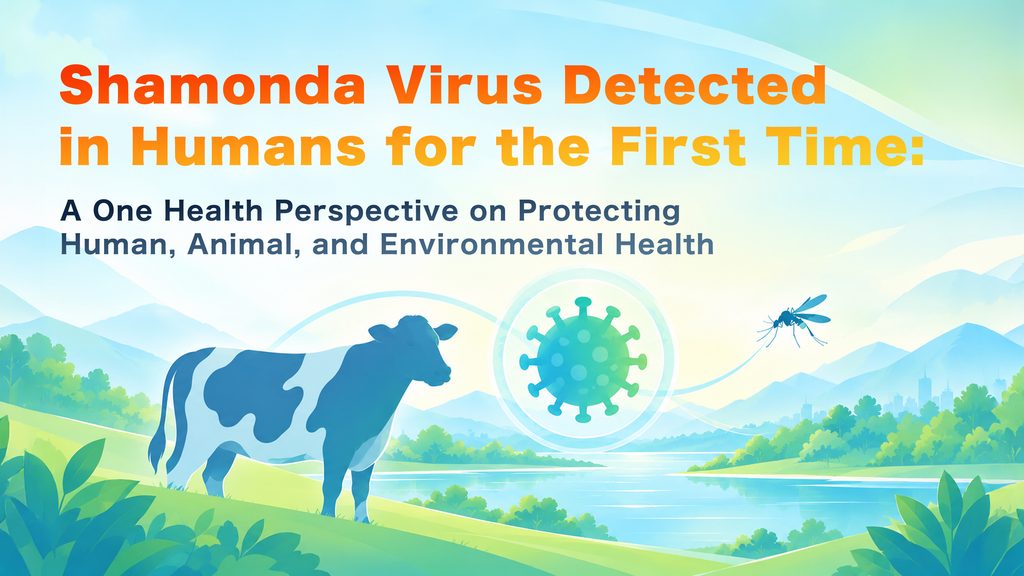
A One Health Perspective on Protecting Human, Animal, and Environmental Health
On October 22, 2026, French health authorities announced that the Shamonda virus, for which no human infections had previously been reported, had been detected in a human for the first time.
According to the announcement, the infection was identified in a severely immunocompromised patient who had been receiving treatment at a medical facility in Lyon, France. The patient died in early October of the same year.
Investigations are currently underway under a One Health approach to determine the route of infection and the possible link between the virus and the patient’s clinical condition. However, based on the evidence currently available, the authorities have stated that no health risk to the general public has been identified.
What Is the Shamonda Virus?
The Shamonda virus is classified within the genus Orthobunyavirus and primarily infects cattle. It is transmitted among animals mainly by small blood-feeding insects known as biting midges (Culicoides).
Since it was first identified in Nigeria in the mid-1960s, the virus has been detected in West Africa, East Africa, and southern Africa. Sporadic cases of Shamonda virus infection in cattle have also been reported in Japan in the past.
In the summer of 2026, the virus was detected in Europe for the first time. In France, sporadic infections have been confirmed not only in cattle-holding facilities but also in small ruminants and equids.
First Confirmed Human Infection
The case reported in France marks the first documented human infection with the Shamonda virus.
French health authorities have suggested that the patient may have been infected through the bite of a virus-carrying biting midge, as the patient had been in eastern France, where outbreaks of the virus in animals had been reported between spring and summer 2026.
The patient also developed neurological complications before death, and a strong suspicion has been raised that these may have been associated with the Shamonda virus infection. However, investigations into the route of infection and the relationship between the virus and the patient’s clinical condition are still ongoing.
Investigation Through a One Health Approach
French authorities have announced that clinical, biological, and epidemiological investigations are continuing under a One Health approach, bringing together expertise in human, animal, and environmental health.
Following notification from French health authorities, the World Health Organization (WHO) issued the following statements and recommendations:
・As the public health risk cannot yet be reliably assessed, continued surveillance and investigation based on a One Health approach are recommended.
・Veterinary authorities in each country and public health authorities across Europe are encouraged to conduct ongoing epidemiological surveillance and assessments using a One Health approach.
・One Health-based investigations should be promoted to gain a more detailed understanding of the characteristics of Shamonda virus infection. Investigations in animals can provide valuable information about the geographical distribution of the virus, its transmission mechanisms, and associated clinical signs. Improving our understanding of infections in animals can help identify areas where humans may be exposed to the virus and support public health risk assessments.
The reason a One Health approach has been adopted in this case is based on the understanding that clarifying the cause and route of infection requires examining not only human health conditions but also information about animals and the environment.
The Shamonda virus is transmitted among animals by small blood-feeding insects known as biting midges. To investigate this case, it is important not only to examine the patient’s infection status and symptoms but also to determine how widely the virus had spread among cattle and other animals in the surrounding area and whether virus-carrying biting midges were present.
By comparing and analyzing these different sources of information, investigators may be able to clarify how the infection occurred and identify factors involved in transmission from animals to humans.
In this way, collaboration among experts from different fields, including human medicine and public health, animal infectious disease control, and investigations into vector insects and the environment, is essential for understanding the nature of infectious diseases and assessing potential health risks.
Human, animal, and environmental health are closely interconnected. This case represents the first detection of the Shamonda virus in a human, following previous reports of infections in animals. It highlights the importance of cross-sectoral investigations in understanding the emergence of infectious diseases and clarifying their transmission pathways.
Taking a comprehensive One Health perspective that integrates information on human, animal, and environmental health can contribute to the early identification of emerging health risks and the development of appropriate preventive measures.
Sources
Ministère de l’Agriculture et de la Souveraineté alimentaire
« Virus Shamonda : une première détection chez l’être humain »

